

Care Robots for Older People in 2025: What Already Works, and What Is Still Experimental
Robots are no longer a sci-fi idea in elder care. In 2025, they can genuinely reduce loneliness, support daily routines, and improve safety at home or in care facilities. But the reality is mixed: social and monitoring functions are already widely deployed, while robots that physically assist with lifting, transfers, or complex household tasks remain limited, expensive, and often still in pilot stages.
What already works in real homes and care facilities
Companionship and daily routine support is one of the most mature areas. Consumer companion robots can start conversations, suggest activities, remind a person about hydration or medication, and help maintain a predictable routine. ElliQ is a clear example of a product designed specifically for older adults, offering conversation, reminders, wellness prompts, and entertainment features that are already used in real-world settings.
Telepresence for family and carers is another capability that is genuinely “here” rather than experimental. Telepresence robots let relatives or clinicians connect through video calls, move around the home (with permission), and check in without relying on the older person to manage a smartphone or laptop. This is often used to reduce isolation and enable remote support, especially for people living alone.
Non-invasive safety monitoring has improved significantly, particularly fall detection and movement monitoring. In practice, many care settings prefer approaches that protect privacy: radar-based, camera-free sensing can detect falls and unusual inactivity while avoiding continuous video recording. Some senior-care programmes built around temi robots integrate these kinds of sensors to trigger alerts and reduce response time.
Core functions that deliver value today (and why they work)
Reminders, check-ins, and cognitive engagement work well because they depend on speech, simple interfaces, and well-tested scheduling logic. These functions do not require the robot to physically manipulate the environment, so reliability is higher. For many older adults, the benefit is not “a robot doing everything”, but a consistent, patient presence that keeps them socially and mentally active.
Call handling and guided communication is practical because it solves a real barrier: when someone struggles with small screens or complex apps, a robot with a dedicated interface can make video calls feel natural. Telepresence becomes especially useful when families are in different cities or countries, and for care teams that want quick visual context without arranging a visit each time.
Safety signals and escalation are effective when the robot is connected to a caregiver workflow: alerts need to reach the right person fast, and the older adult should not be forced to confirm multiple prompts during stress. The best systems focus on “detect + notify + verify” rather than pretending to fully replace human judgement, which is why privacy-preserving fall and motion monitoring has gained traction.
Robots that assist with physical tasks: real progress, but still limited
Picking up objects, fetching items, and basic manipulation is possible, but not yet common in private homes. Toyota’s Human Support Robot (HSR) demonstrates how a mobile robot with an arm can retrieve objects from the floor and shelves, which is directly relevant for older people with reduced mobility. However, HSR has largely been offered to research partners, which shows that the technology is strong but still not broadly mainstream as a consumer appliance.
Transfers and weight-bearing assistance are far more challenging than reminders or calls. A robot supporting a human body must be safe in unpredictable situations: slippery floors, sudden loss of balance, fatigue, and panic reactions. In 2025, the most advanced systems are still frequently tested in controlled settings, even when prototypes show promising results.
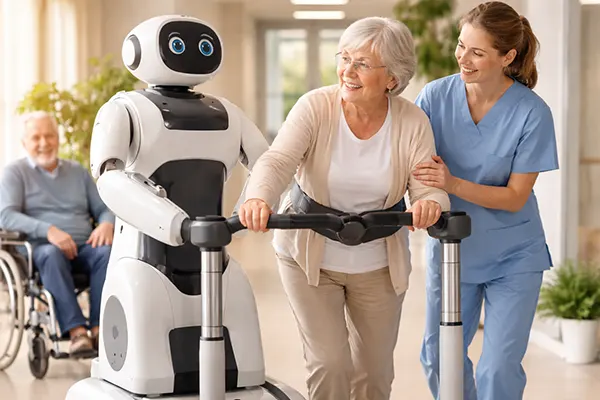
Fall prevention with physical support is an area where prototypes are becoming more convincing. Engineers have tested mobile robots designed to support a person’s full weight, assist with sitting and standing, and help prevent falls. That is a major engineering step, but it also highlights how complex and specialised these machines are compared with everyday companion robots.
Why “hands-on” eldercare robots are harder than they look
Safety engineering is unforgiving. If a conversational robot makes a mistake, the harm is usually limited to frustration. If a physical-assist robot makes a mistake, the risk can include fractures, head injuries, or severe fear that reduces confidence. That is why developers invest heavily in redundancy, force control, and cautious movement planning, which slows mass adoption.
Homes are messy and unpredictable. Real homes have rugs, narrow doorways, pets, clutter, and furniture that changes position. Robots that can reliably manipulate objects in that environment need robust perception and planning. In 2025, many teams focus on more adaptable robot “brains” to help machines generalise across different rooms and layouts, but the field is still evolving.
Cost, maintenance, and trust remain barriers. Physical robots need servicing, calibration, and sometimes environmental adjustments. Many families will accept a robot for communication, reminders, or monitoring, but hesitate when the device is expected to move close to a frail person’s body. Trust is built over time, and the sector is still earning it.
What is still mostly prototype in 2025, and what to watch next
Full household task automation (cooking complete meals, doing laundry end-to-end, cleaning reliably in every corner) is still mostly out of reach for eldercare robots. Some single-purpose devices exist, but a general “home helper” that can handle varied chores safely, day after day, is still a research ambition rather than a normal purchase.
Clinical-grade health assessment without clinicians is also not fully there. Robots can prompt check-ins, track basic patterns, and support adherence to routines, but diagnosing or adjusting treatment safely requires regulated medical systems and professional oversight. Many research projects explore these directions, yet mainstream deployment remains cautious.
Emotion recognition and mental health intervention is another area where marketing sometimes runs ahead of reality. A robot can detect patterns in speech or behaviour and suggest support, but it cannot replace a trained mental health professional. The best use in 2025 is early signalling: helping families and care teams notice changes sooner, not pretending to provide therapy.
How to evaluate an eldercare robot realistically (a 2025 checklist)
Start with the problem, not the gadget. If the main issue is loneliness, look for strong conversation design, proactive engagement, and easy calling features. If the issue is safety, prioritise proven fall detection and clear caregiver alert pathways, ideally with privacy-respecting sensing.
Check what happens when things go wrong. Ask: does it keep working during Wi-Fi issues, power cuts, or software updates? Does it fail safely? Is there a clear escalation path to a human caregiver? The practical value of a robot is defined by reliability under real-world stress, not by demo-day features.
Demand transparency about data and consent. For older adults, trust is built when the device is predictable: what it records, who can access it, and how permissions are managed. In 2025, privacy and security are not optional extras in elder care technology—they are part of basic safety.