
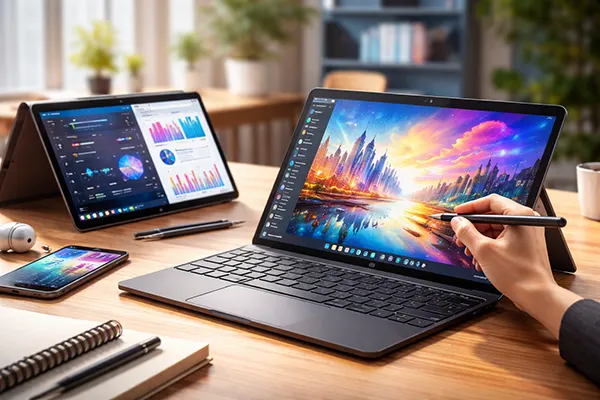
Hybrid Devices for Work and Creativity: Where the Ultramobile Technology Market Is Heading
Over the past decade, portable computing has moved far beyond the traditional laptop. Professionals now expect a single device to support writing, design, meetings, coding, and media work without switching hardware. This demand has driven rapid development in hybrid ultramobile devices — machines that combine the flexibility of tablets with the productivity of laptops. By 2026 the market includes detachable computers, foldable displays, and powerful pen-enabled systems designed for creative and professional tasks. Manufacturers are now focusing not only on mobility but also on performance, battery efficiency, and seamless integration with modern workflows.
The Evolution of Hybrid Computing Devices
Hybrid computers began gaining traction in the mid-2010s when manufacturers introduced detachable keyboards and touch displays. Early devices such as the Microsoft Surface Pro demonstrated that a tablet could also function as a serious work tool when paired with desktop-grade software. Since then, the category has expanded significantly, attracting manufacturers including Lenovo, ASUS, HP, and Apple.
By 2026, hybrid hardware typically features high-resolution OLED or mini-LED screens, lightweight magnesium or aluminium bodies, and advanced processors built on ARM or energy-efficient x86 architectures. Apple’s M-series chips and Qualcomm’s Snapdragon X processors have shown that portable systems can deliver strong performance while maintaining long battery life, often exceeding 15 hours in typical office workloads.
The shift toward hybrid designs reflects broader changes in how people work. Remote collaboration, digital sketching, cloud-based editing tools, and video conferencing all benefit from touch interfaces and stylus support. These features have made hybrid devices particularly attractive for designers, students, developers, and journalists who move frequently between work environments.
Design Trends Shaping Modern Hybrids
One noticeable trend in 2026 is the move toward thinner and lighter designs without sacrificing performance. Many hybrid devices weigh under one kilogram yet still include full desktop operating systems and support for professional applications such as Adobe Creative Cloud or engineering software.
Another development involves flexible form factors. Some devices feature 360-degree hinges that allow the keyboard to fold behind the screen, transforming a laptop into a tablet. Others use detachable displays, enabling the screen to function independently while the keyboard acts as a portable docking station.
Manufacturers are also focusing heavily on stylus technology. Modern pens support thousands of pressure levels, tilt detection, and near-zero latency. These improvements make digital drawing, note-taking, and annotation feel much closer to traditional pen and paper.
Performance and Hardware Capabilities in 2026
One of the biggest concerns about ultramobile devices in the past was limited computing power. That concern is fading rapidly. Hybrid systems released between 2024 and 2026 increasingly include processors capable of handling video editing, 3D rendering previews, and complex multitasking.
Apple’s M3 and M4 chips, Intel’s Meteor Lake architecture, and Qualcomm’s Snapdragon X Elite processors illustrate how energy-efficient designs can deliver workstation-level performance. These processors integrate powerful graphics units and AI acceleration engines that support tasks such as image upscaling, real-time transcription, and intelligent background processing.
Memory and storage have also improved significantly. Many premium hybrid devices now ship with 16–32 GB of RAM and fast NVMe storage exceeding 1 TB. Combined with cloud synchronisation services, this allows professionals to work with large media libraries or software development environments even while travelling.
The Role of AI in Ultramobile Devices
Artificial intelligence is increasingly embedded directly into modern hardware. Dedicated neural processing units enable tasks such as local speech recognition, background noise removal in video calls, and automatic image enhancement without relying on cloud services.
Operating systems are also integrating AI assistants that help organise files, summarise documents, and assist with coding or research tasks. By processing these features locally, hybrid devices can offer faster response times and improved privacy.
Creative professionals are particularly benefiting from these capabilities. Applications for photo editing, illustration, and music production increasingly use AI-assisted tools that accelerate complex tasks while allowing users to maintain control over the final result.
Future Directions of the Ultramobile Market
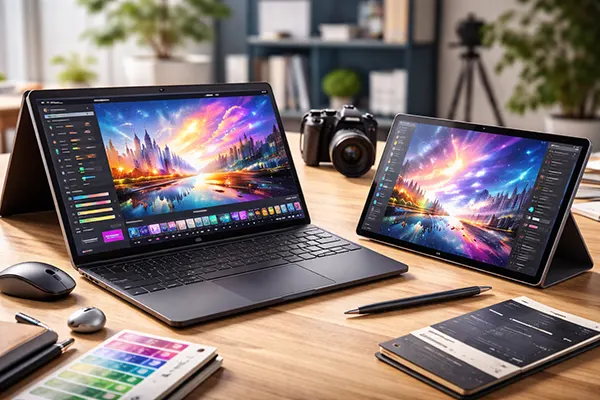
The next phase of ultramobile technology will likely focus on flexibility and modular design. Foldable displays, already introduced by companies such as Lenovo and ASUS, allow devices to transform from compact tablets into larger workspaces suitable for multitasking or digital illustration.
Another expected direction involves deeper integration with cloud infrastructure. As internet connectivity improves through widespread 5G and emerging 6G research, hybrid devices will rely more on cloud processing for heavy workloads while maintaining efficient local performance for everyday tasks.
Sustainability is also becoming an important factor in product development. Manufacturers are increasingly using recycled aluminium, repairable components, and longer software support cycles. These changes respond to growing environmental awareness among consumers and regulatory pressure in regions such as the European Union.
How Hybrid Devices Are Changing Creative Work
For creative professionals, hybrid devices are redefining how projects are produced and shared. Designers can sketch ideas directly on the screen during meetings, edit graphics while travelling, and finalise files on external displays once back at a desk. This continuity shortens the gap between concept and execution.
Musicians and video creators are also benefiting from mobile production setups. Modern hybrids can run professional editing software, manage large audio sessions, and export high-resolution video without requiring traditional desktop workstations.
Looking ahead, the boundary between tablet, laptop, and creative workstation will likely continue to blur. Advances in battery technology, flexible displays, and AI-driven software suggest that ultramobile devices will remain central tools for both productivity and creative exploration in the years ahead.