
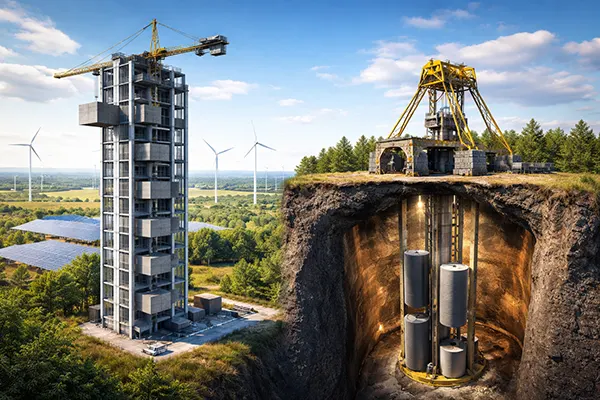
Gravitational Energy Storage in 2026: Mine-Shaft and Tower Systems
Gravitational energy storage is one of the more practical “mechanical battery” ideas to reach commercial scale: you use surplus electricity to lift mass, then recover electricity by letting that mass descend through a generator. In 2026 it sits in a useful middle ground between fast-response batteries and geography-limited pumped hydro. The attraction is straightforward—long service life, minimal performance fade from cycling, and materials that can often be sourced without the same supply-chain pressure seen in some electrochemical cells. The hard part is equally straightforward: you need the right site, strong civil and mechanical engineering, and a business case that values multi-hour shifting and grid services.
Why gravity storage matters on 2026 power systems
Electricity grids in 2026 are dealing with higher shares of variable wind and solar, and that creates two common headaches: intraday imbalance (day-to-night shifting) and short, sharp ramps when weather changes. Gravity storage targets these operational gaps by providing multi-hour discharge while still responding quickly enough for frequency support and ramp control. Unlike many chemical batteries, a gravity system’s energy capacity can be scaled by adding mass, height, or travel distance, while power is set mainly by motor-generator size and the mechanical handling system. That separation between “power hardware” and “energy inventory” is a big reason utilities keep the concept on the table.
It also helps that gravity systems can be designed for high cycle counts with predictable degradation pathways. With fewer electrochemical failure modes, owners often focus on classic industrial risks—wear on cables, bearings, brakes, and hoist components, plus corrosion control and inspection regimes. In practice, this can translate into long asset lives if maintenance is done properly, but it also means you cannot treat the system like a sealed box: operational discipline is part of the technology. For planners, the promise is not magic efficiency; it is dependable dispatchability and a cost profile that can stay stable over decades.
That said, gravity storage is not a universal replacement for batteries or pumped hydro. Round-trip efficiency depends on design choices (friction losses, motor-generator performance, power electronics, and control strategy), and the economics are sensitive to local labour, construction costs, and market revenues for capacity and ancillary services. The technology makes the most sense where curtailment is frequent, where evening peaks are costly, or where a site’s existing vertical infrastructure can cut capital expenditure. In other words, the best projects start with a grid problem and a site advantage—not with a generic wish for “long duration.”
Key performance metrics that decide whether a project is bankable
For investors and system operators, the first filter is usually the pairing of power rating (MW) and usable energy (MWh), because that defines which revenue streams are even possible. Multi-hour shifting needs enough energy to matter at peak times, while grid services need power that can ramp reliably and meet dispatch instructions. Gravity projects also need to demonstrate consistent response times, stable control under partial load, and safe “fail-to-stop” behaviour if there is a fault. Those requirements sound basic, but they are where mechanical detail meets grid compliance.
The next filter is efficiency and availability, treated realistically rather than as marketing numbers. Mechanical systems lose energy to friction, aerodynamic drag, electrical conversion losses, and auxiliary loads such as cooling, monitoring, and safety systems. A credible project will show how efficiency changes with power level, temperature, and ageing of components, and it will have a maintenance plan that protects availability during high-value seasons. If the business case only works at a single perfect efficiency number, it is fragile.
Finally, there is the siting and permitting story. Tower systems raise questions about noise, visual impact, construction logistics, and local acceptance, while mine-shaft concepts depend on ground conditions, shaft integrity, and water management. The bankable projects are the ones that treat permitting as engineering work—surveying, monitoring, and documenting risks—rather than as paperwork. In 2026, developers who can prove predictable build schedules and safe operations usually move faster than those who only talk about theoretical advantages.
Mine-shaft gravity systems: reusing vertical infrastructure
Mine-shaft gravity storage takes advantage of what already exists: deep vertical shafts and heavy-duty industrial access. The core mechanism is simple—weights are lifted when power is cheap or abundant, then lowered to produce electricity—but the engineering is not trivial. You need robust hoists or winches, high-integrity braking systems, precise control of descent speed, and continuous monitoring of loads. The shaft itself becomes part of the asset, so its condition, lining, and long-term stability are central to the design.
In 2026, the most compelling mine-shaft proposals are often in regions where mines are closing and communities want new industrial jobs without rebuilding from scratch. A shaft can offer large vertical travel, which helps energy capacity, but it can also create constraints: limited space for equipment, ventilation requirements, and strict safety rules for access. Water ingress is another recurring issue; even when the storage concept does not rely on water, groundwater management affects maintenance, corrosion, and uptime. The best designs treat the shaft as a harsh industrial environment, not as a clean laboratory.
There are also “mine as pumped storage” approaches, where water is moved between underground and surface reservoirs using existing voids, but that pushes the project into hydro-style civil works and environmental approvals. Some sites can support that route, especially where geology is favourable and existing underground volumes are well mapped. Others are better suited to pure mechanical weight systems because they keep the working fluid out of the permitting debate. Either way, the headline lesson is the same: reuse can reduce costs, but only if the asset is well characterised.
Engineering realities: safety, wear, and site verification
The dominant risks for mine-shaft gravity systems are mechanical and operational. Cable fatigue, drum wear, and brake performance need conservative design margins, because the stored energy is literally a suspended hazard if controls fail. Modern systems lean on redundant braking, overspeed protection, and continuous sensor data to detect abnormal vibrations or load changes early. In practice, maintenance is not a cost to minimise; it is the condition for keeping availability and safety acceptable.
Site verification is where many proposals succeed or fail. A developer needs reliable surveys of shaft geometry, integrity of linings, anchoring points for hoists, and the behaviour of surrounding rock under cyclic loading. Even small uncertainties can cascade into major design changes once construction starts. That is why credible projects invest early in inspections, mapping, and test lifts, rather than assuming an old shaft will behave like a new one.
Commercial progress also depends on proving that the system can meet grid operator requirements repeatedly. Demonstration work in this area has helped move the concept from theory to engineering practice, including projects that have tested full power delivery and controlled operation in real conditions. In 2026, the remaining question is less “can it work?” and more “can it be replicated at predictable cost and schedule across many sites?” Replicability, not novelty, is what turns a good idea into an investable asset class.
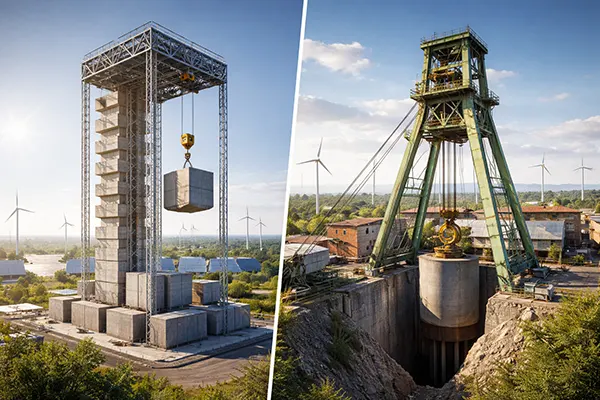
Tower-based gravity systems: purpose-built structures for modular storage
Tower-based gravity storage flips the mine concept on its head: instead of reusing an underground shaft, you build a vertical structure above ground and move modular masses within it. The well-known architecture uses stacked blocks or similar masses that are lifted by cranes or hoists, then lowered to regenerate electricity. The attraction is siting flexibility—no need for special topography—and the ability to build near substations, renewable generation, or industrial loads. In 2026, this approach is most often discussed as long-duration storage that can complement lithium-ion installations on the same grid node.
Real-world progress matters here, because tower systems have faced scepticism about construction complexity and cost. Developers have responded by shifting towards more standardised industrial components, tighter automation, and designs that look less like a one-off mega-structure and more like repeatable infrastructure. A key milestone has been commissioning and grid interconnection of commercial-scale projects, which helps validate controls, safety systems, and dispatch performance under real grid conditions. That kind of evidence is what procurement teams want before signing long-term capacity contracts.
Tower systems also have practical constraints. They require land, heavy construction logistics, and community acceptance for tall structures. They must handle wind loading, seismic considerations where relevant, and the operational realities of moving heavy masses thousands of times per year. For that reason, many developers position towers for industrial zones where heavy equipment is normal, and where noise and visual impact are easier to manage. As with mine systems, the best sites are the ones where civil engineering risk is lower than the value of the grid services the system can provide.
How tower projects compete with batteries and pumped hydro in 2026
Against lithium-ion, the tower argument is usually about longevity and scaling energy without scaling cell count. Batteries excel at fast response and compact footprint, but they can face replacement cycles and performance fade that affect long-term economics. A gravity tower can be attractive when a buyer wants multi-hour energy shifting for decades, values low degradation, and can accept a larger footprint. In procurement terms, it is a different risk profile: more civil and mechanical risk upfront, potentially less electrochemical risk later.
Against pumped hydro, towers compete on siting rather than raw scale. Pumped hydro remains a proven large-scale option, but it is often constrained by geography, permitting, and long build times. A tower can be built closer to load and generation, and it avoids the need for large water reservoirs, but it typically cannot match the multi-gigawatt scale of the biggest hydro schemes. In markets where speed to deployment and site availability matter more than maximum size, towers can be a practical alternative.
The honest view in 2026 is that gravity towers will not win everywhere, but they do not need to. They only need to be the least-risk option for a subset of sites where grid congestion, curtailment, or evening peaks create clear value. When that value is backed by long-term contracts—capacity payments, availability incentives, or industrial off-take agreements—the technology can stand on predictable cash flows rather than optimistic spot-price assumptions. That shift, from “interesting tech” to “contractable asset,” is what ultimately decides whether the sector grows.