
Contactless Gesture Control Interfaces for Transport and Everyday Environments
Contactless gesture control has moved from research laboratories into real vehicles, public transport systems and domestic interiors. By 2026, infrared sensors, depth cameras, radar modules and AI-based vision processors allow drivers and passengers to interact with equipment without touching physical buttons. This shift is driven by safety, hygiene, accessibility and design flexibility. In cars, trains and smart homes, gesture interfaces are no longer experimental prototypes but commercially deployed systems developed by companies such as BMW, Mercedes-Benz, Continental, Bosch and Sony. Understanding how they work, where they are applied and what limitations they still face is essential for engineers, designers and operators planning future transport and building solutions.
Technological Foundations of Gesture Recognition Systems
Modern gesture interfaces rely on a combination of hardware sensing and machine learning algorithms. In automotive applications, 3D time-of-flight cameras and infrared illumination modules track hand movements in low-light conditions, while short-range radar sensors detect micro-motions without requiring visible light. Radar-based gesture sensing analyses Doppler shifts to interpret finger or hand movements with millimetre precision.
Computer vision plays a central role in systems that use cameras. Neural networks trained on large datasets classify predefined gestures such as swiping, rotating or pointing. In 2026, embedded AI chips allow these calculations to run locally inside vehicles and household devices, reducing latency and improving privacy. Edge processing ensures that video data does not need to be continuously transmitted to external servers.
Signal fusion is increasingly important. Instead of relying on a single sensor, manufacturers combine radar, optical and capacitive inputs to minimise false positives. Environmental factors such as sunlight glare, vibration or passenger movement can interfere with detection, so adaptive filtering algorithms continuously adjust sensitivity levels. This multi-layer architecture significantly improves reliability compared with early-generation systems.
Accuracy, Latency and Safety Considerations
In transport applications, accuracy is directly linked to safety. Gesture interfaces must comply with functional safety standards and be validated under different lighting conditions, driver postures and road vibrations. Developers conduct extensive scenario testing to reduce misinterpretation risks.
Latency is another critical factor. By 2026, optimised systems achieve response times below 100 milliseconds, which users perceive as near-instantaneous. Engineers prioritise local data processing and lightweight neural network models to maintain this performance.
Human factors research shapes deployment strategies. Most commercial systems focus on simple actions such as volume adjustment, call acceptance and menu scrolling. Limiting the gesture vocabulary reduces cognitive load and supports safer driving behaviour.
Applications in the Automotive and Public Transport Sector
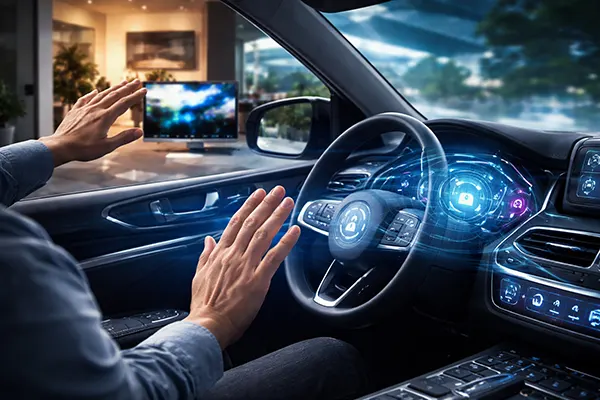
Premium automotive brands introduced gesture control into production vehicles during the late 2010s, and by 2026 the technology is integrated into a wide range of electric and hybrid models. Gesture commands typically manage infotainment, navigation inputs and cabin settings.
In semi-autonomous driving modes, passengers can interact with large central displays using mid-air gestures. This approach supports new interior layouts where traditional control panels are minimised.
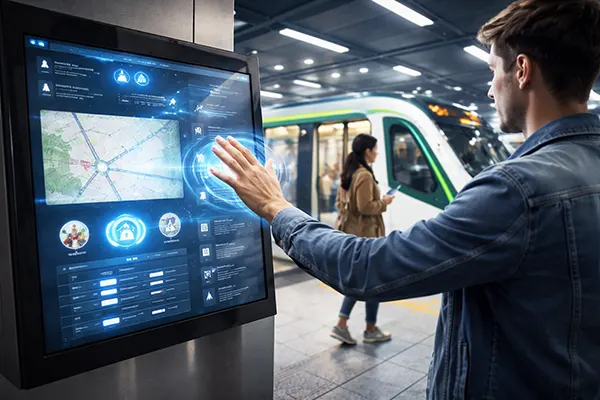
Public transport environments are also testing contactless kiosks and ticketing machines controlled by hand movements. These installations aim to reduce surface contact and improve accessibility in busy stations and airports.
Integration with Autonomous and Electric Mobility
Autonomous vehicle concepts incorporate gesture control as part of fully digital cabin ecosystems. Occupants seated in lounge-style configurations can manage media or environmental settings without reaching for fixed panels.
Electric vehicle design benefits from reduced mechanical complexity. Gesture interfaces contribute to streamlined dashboards and fewer physical components, aligning with minimalist interior trends.
Regulatory bodies continue to assess driver distraction levels. Current evidence indicates that well-designed systems used for non-critical functions do not significantly increase risk when compared with touchscreen interfaces.
Gesture Control in Domestic and Smart Building Environments
Smart homes increasingly integrate gesture recognition into lighting, entertainment and climate systems. Users can adjust settings with simple hand movements, particularly in environments where voice control is impractical.
Healthcare facilities adopt gesture-operated displays to maintain sterile conditions. Surgeons can navigate imaging data without touching shared equipment, improving hygiene standards.
Commercial buildings implement contactless lift panels and shared workspace controls using infrared or radar sensors. Privacy-focused designs avoid storing identifiable video data and comply with European data protection rules.
Accessibility, Privacy and Future Development
Gesture interfaces offer improved accessibility for individuals who struggle with small touchscreens or physical buttons. Adaptive sensitivity settings allow systems to respond to varied movement capabilities.
Privacy safeguards are central to public acceptance. Best practice in 2026 includes on-device processing, encrypted data handling and transparent user consent mechanisms.
Future development is likely to focus on smaller, more energy-efficient sensors and improved AI models. Gesture control will remain a complementary interface, supporting touch and voice in both transport and everyday environments.