
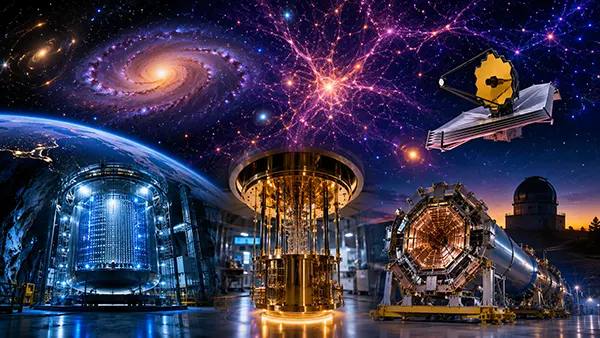
Dark Matter in 2026: Which Experiments Are Bringing Physicists Closer to the Answer
Dark matter remains one of the most important unsolved questions in modern physics. By 2026, researchers still have no confirmed particle detection, yet the field has moved into a far more precise stage. The strongest experiments no longer simply ask whether dark matter exists; astronomical evidence already makes that case compelling. They now test specific particle masses, interaction strengths and theoretical models with instruments sensitive enough to register signals close to the natural background created by neutrinos, radioactivity and cosmic rays.
Why Dark Matter Research Has Entered a More Precise Phase in 2026
The reason dark matter is taken seriously is not based on one observation. Galaxy rotation curves, gravitational lensing, the cosmic microwave background and the formation of large-scale cosmic structure all point to additional matter that does not emit, absorb or reflect light in the usual way. Ordinary matter made of atoms cannot explain the measured gravitational behaviour of galaxies and galaxy clusters. The best current estimate is that dark matter accounts for most of the matter in the Universe, while stars, planets, gas and dust form only a smaller visible share.
What has changed by 2026 is the level of experimental control. Earlier searches often covered broad theoretical territory with limited sensitivity. Current experiments use larger detectors, cleaner materials, deeper underground laboratories and more advanced statistical methods. A null result today is not simply a failure to detect something; it removes part of the allowed parameter space and forces theorists to refine models. That is why recent results from liquid xenon detectors, cryogenic crystal experiments and axion haloscopes are scientifically valuable even when they do not show a confirmed dark matter signal.
The field has also become more diverse. For many years, weakly interacting massive particles, usually called WIMPs, dominated experimental planning. They are still an important target, but they are no longer the only serious candidate. Physicists now look for lighter dark matter, axions, hidden-sector particles, dark photons and indirect signatures in cosmic surveys. This broader approach matters because nature may not have chosen the simplest particle model. In 2026, progress comes from comparing several experimental routes rather than waiting for one detector to solve the problem alone.
Why Underground Detectors Still Matter
Underground laboratories remain central because dark matter interactions, if they happen at all, are expected to be extremely rare. Cosmic rays constantly strike Earth’s surface and can imitate or obscure the tiny signals researchers are trying to measure. Placing detectors deep underground reduces that background sharply. Facilities such as the Sanford Underground Research Facility in the United States and SNOLAB in Canada give experiments the quiet conditions needed to search for energy deposits that may occur only a few times per year, or even less often.
The most sensitive direct-detection experiments also depend on materials that are unusually clean. Detector components must contain very low levels of radioactive contamination, because even a trace amount of uranium, thorium or radon can produce misleading events. In liquid xenon experiments, purification systems remove radioactive isotopes and electronegative impurities. In cryogenic experiments, crystals are cooled to temperatures close to absolute zero so that very small deposits of energy can be measured through ionisation, phonons or scintillation.
These technical improvements explain why the absence of a discovery has not weakened the field. Instead, it has made the question sharper. If WIMPs exist in the mass ranges tested by LZ, XENONnT and PandaX-4T, they must interact more weakly than many earlier models predicted. If lighter particles exist, experiments such as SuperCDMS are better suited to finding them. If axions are responsible for dark matter, radio-frequency experiments such as ADMX search in a completely different way. Each method narrows the answer from a different side.
Liquid Xenon Experiments and the Search for WIMPs
Liquid xenon detectors are among the most powerful instruments in direct dark matter detection. Their strength comes from scale, density and signal separation. When a particle interacts inside liquid xenon, it can produce prompt light and a delayed charge signal. Comparing these two signals helps researchers distinguish possible nuclear recoils, which could come from dark matter, from electronic recoils caused by more ordinary background events. This dual-signal method has made xenon time projection chambers a leading technology in the WIMP search.
The LUX-ZEPLIN experiment, known as LZ, is one of the key projects in this area. Located deep underground in South Dakota, it uses several tonnes of liquid xenon and is designed to test WIMP interactions at extremely low cross sections. By 2026, LZ has already produced world-leading constraints and continues to collect science data toward a much larger exposure. Its importance is not only its size, but also its ability to understand backgrounds in detail. Solar neutrinos, detector materials and trace radioactivity all have to be modelled carefully before any rare event can be interpreted as new physics.
XENONnT in Italy and PandaX-4T in China provide essential independent comparison. XENONnT has focused heavily on reducing radioactive background inside its xenon target, while PandaX-4T has reported strong limits using tonne-year exposure data. This matters because a future claim of dark matter detection will need confirmation by more than one collaboration. If one detector sees a possible signal, other experiments with different designs, locations and analysis methods must be able to test it. The global xenon programme therefore works as a network of cross-checks rather than a single race.
What Null Results Really Tell Physicists
When an experiment reports no significant excess, it may sound disappointing outside the scientific community. In practice, such results are often highly informative. They show that certain combinations of particle mass and interaction strength are unlikely. For WIMP models, this is usually expressed as an upper limit on the scattering cross section between dark matter particles and nucleons. The lower that limit becomes, the smaller the remaining space for traditional WIMP scenarios.
By 2026, the strongest xenon experiments are approaching a region where solar and atmospheric neutrinos become increasingly important. This is sometimes called the neutrino floor, although it is not a strict barrier. Neutrinos can produce nuclear recoils that look similar to dark matter signals. Instead of ending the search, this creates a new challenge: detectors must become good enough to separate direction, timing, energy spectrum and event populations with much greater precision. In that sense, dark matter research is also becoming neutrino physics.
These null results also influence theory. Models that once appeared natural may now require weaker couplings, different mediator particles or alternative production mechanisms in the early Universe. Some researchers have shifted more attention to sub-GeV dark matter, axion-like particles or hidden sectors. This does not mean WIMPs are ruled out entirely. It means the simplest versions are under stronger pressure, while more detailed models must match increasingly strict experimental evidence.

Low-Mass Dark Matter, Axions and Hidden-Sector Searches
SuperCDMS SNOLAB is one of the most important experiments for low-mass dark matter in 2026. Unlike large xenon detectors that are especially strong for heavier WIMPs, SuperCDMS uses germanium and silicon crystals cooled to extremely low temperatures. This design allows it to measure very small energy deposits, making it suitable for dark matter particles lighter than the traditional WIMP range. Its location deep underground at SNOLAB gives it shielding from cosmic radiation, while cryogenic technology helps separate possible signals from background noise.
The experiment reached an important commissioning stage before its first science data run. Its scientific value lies in the mass range it targets. If dark matter is lighter than a few proton masses, it may not produce enough recoil energy to be seen clearly in larger xenon detectors. Cryogenic crystal experiments can test that lower-mass territory with better sensitivity. This is why SuperCDMS is not a duplicate of LZ or XENONnT; it answers a different version of the dark matter question.
Axion searches represent another major direction. The axion was originally proposed to solve a problem in quantum chromodynamics, but it also became a strong dark matter candidate. ADMX searches for axions by using a strong magnetic field and a resonant microwave cavity. If axions pass through the apparatus, they may convert into detectable photons at a frequency related to their mass. By 2026, ADMX has reported results covering new frequency ranges with sensitivity to well-motivated axion models, making it one of the clearest examples of how dark matter searches now depend on precision radio-frequency measurement as much as particle recoil detection.
Why Collider and Telescope Data Are Also Needed
Direct detection is only one part of the search. Collider experiments at CERN test whether dark-sector particles can be produced in high-energy collisions. ATLAS, CMS, FASER, NA64 and related programmes look for missing energy, long-lived particles, dark photons, millicharged particles and other unusual signatures. These searches cannot prove that a newly produced particle makes up cosmic dark matter by themselves, but they can reveal the kind of hidden-sector physics that may connect ordinary matter to the dark sector.
Astrophysical surveys add another layer of evidence. ESA’s Euclid mission is mapping the large-scale structure of the Universe by observing huge numbers of galaxies across cosmic time. It does not detect dark matter particles directly. Instead, it measures how invisible mass shapes galaxy clustering and bends light through gravitational lensing. These data help test whether the standard cosmological model remains consistent when measured with higher precision. If the distribution of matter does not match predictions, it could point to new physics in dark matter, gravity or dark energy.
The most realistic path to an answer is therefore multi-channel confirmation. A convincing discovery may require a direct detector signal, compatible collider constraints and astrophysical evidence that supports the same particle model. In 2026, no experiment has delivered that final confirmation, but the field is closer in a practical sense: backgrounds are better understood, sensitivity has improved, and several candidate models are being tested with serious precision. Dark matter remains unseen, yet the space in which it can hide is becoming smaller, better mapped and harder to defend with vague theory.