
Volkswagen Launches Vehicle-to-Grid in 2026: How Electric Cars Will Return Power to the Grid
Volkswagen is preparing to turn electric cars into something more than a means of transport. In 2026, the German manufacturer and its energy subsidiary Elli are introducing Vehicle-to-Grid (V2G) technology, allowing compatible electric vehicles to store electricity and return it to the public grid when needed. The commercial launch is planned for Germany in the fourth quarter of 2026, with other European countries expected to follow. The technology could help drivers reduce charging costs, earn rewards for making their batteries available and support electricity networks increasingly dependent on renewable energy. However, access will depend on vehicle compatibility, charging equipment and local energy arrangements.
Volkswagen’s Vehicle-to-Grid Launch: What Changes in 2026?
Volkswagen officially announced its new V2G initiative on 16 April 2026, outlining plans to introduce a complete home energy solution for private customers. The company provided further details on 23 June at the Power2Drive exhibition in Munich, where Elli presented its bidirectional charging equipment and associated services. The initial programme covers Germany and involves Volkswagen passenger cars, Volkswagen Commercial Vehicles and CUPRA. Customers have been able to register their interest since June, while commercial availability and equipment orders are planned for the final months of 2026. As of November, this remains a phased introduction rather than a service available to every Volkswagen electric car owner.
The idea is straightforward: instead of remaining unused while parked, an electric car’s battery can help supply electricity when demand increases. Volkswagen estimates that around one million electric vehicles built on its MEB electric architecture are already technically prepared for bidirectional charging across Europe, including approximately 360,000 in Germany. These figures describe technical readiness, not the number of vehicles already supplying electricity to national grids. Volkswagen is working with Elli to connect suitable cars, domestic chargers, electricity meters and energy tariffs into a service that ordinary households can manage without specialist knowledge.
The financial opportunity is one of the main reasons for the launch. Volkswagen initially discussed potential annual benefits of €700–€900 under particularly favourable conditions. Its more detailed June announcement introduced a possible plug-in bonus of up to €720 during the first contract year. Neither figure represents guaranteed annual earnings for every driver. Payments depend on the programme’s conditions and how much flexibility customers can offer. The important distinction is that owners may receive compensation for making their battery available, rather than simply selling every spare unit of electricity at a fixed price.
How Vehicle-to-Grid Works in Everyday Driving
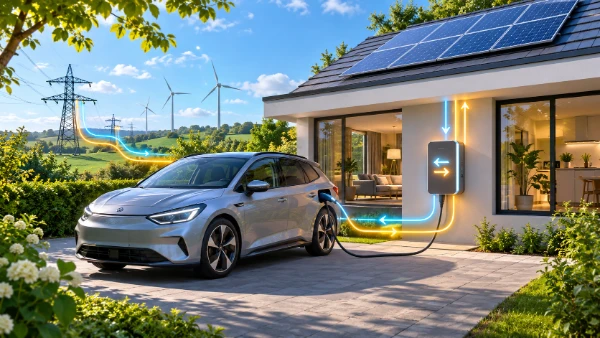
Most electric cars operate with one-way charging: electricity moves from the grid through a charger into the vehicle’s battery. Vehicle-to-Grid reverses that process when appropriate. A compatible car can charge when electricity is plentiful or comparatively inexpensive, retain that energy and later send some of it back through a bidirectional charger. For example, a car connected at home during the afternoon could store surplus renewable electricity and make a portion available during the evening, when demand often increases. The owner does not need to decide manually when to export power because the connected energy management system handles those decisions.
Volkswagen’s approach allows drivers to establish important limits through the Elli BiDi App. They can specify when they need their vehicle again and the minimum battery charge that must remain available. Imagine arriving home at 6 pm with 70% charge and needing the car for work at 8 am. The system can use the available hours to manage charging and potentially return electricity to the grid, while respecting the selected charge requirement. How much energy can actually be supplied depends on the vehicle, battery level, connection time and applicable operating rules. The system is designed around the driver’s transport needs rather than requiring them to sacrifice their next journey.
Vehicle-to-Grid also differs from two related technologies. Vehicle-to-Home (V2H) allows a car battery to supply electricity to a household, potentially reducing purchases from the grid during expensive periods. Vehicle-to-Load (V2L) powers compatible electrical appliances or equipment directly from a vehicle. V2G goes further because electricity enters the wider public network, where it can help balance supply and demand. All three use the principle of bidirectional energy flow, but they require different arrangements and are not automatically available on every electric vehicle. Volkswagen’s 2026 programme specifically addresses participation in the electricity market through its managed V2G service.
Which Volkswagen Electric Cars Can Use Vehicle-to-Grid?
Volkswagen’s initial compatibility plans include ID. vehicles equipped with ID. Software 3.5 or later and a battery capacity of at least 77 kWh. The manufacturer also plans support for all ID. models running ID. Software 6, extending bidirectional functionality beyond the larger battery versions. This could make the technology relevant to vehicles from the ID.3, ID.4, ID.5 and ID.7 families, depending on their individual specifications. The ID. Buzz is another important example within Volkswagen Commercial Vehicles. Nevertheless, belonging to the ID. family does not automatically establish eligibility. Owners must confirm their particular vehicle’s battery, software version and approved charging configuration.
Existing electric cars are especially significant because Volkswagen is not relying exclusively on newly manufactured vehicles. Many ID. models produced with suitable battery systems have been technically prepared for bidirectional charging since late 2023. Software support has gradually expanded the possibilities, although a software update alone cannot compensate for missing hardware or unsuitable battery specifications. Volkswagen’s June announcement also identified CUPRA vehicles among the intended participants, reflecting the shared technology used across several Group brands. This larger existing fleet could allow V2G adoption to grow without requiring every interested customer to purchase a completely new electric car.
Compatibility is only the first requirement. The planned service combines an Elli BiDi Charger, the Volkswagen Naturstrom V2G Flow electricity tariff, the Elli BiDi App and suitable metering equipment. The charger is designed to support electricity moving both into and out of the battery, unlike an ordinary one-way home charger. A smart meter records electricity flows so the energy service can account for charging and exports accurately. Volkswagen has arranged access to a specialist metering provider in Germany, with smart meter installations expected to take approximately eight to ten weeks under the announced process. Customers should also account for installation costs, electrical suitability and contract conditions when assessing the offer.
Battery Life, Driving Range and the Cost of Installation
A common concern is whether regularly exporting electricity will wear out the battery more quickly. Lithium-ion batteries experience gradual ageing through use and time, so additional charging and discharging cannot be treated as having absolutely no effect. Volkswagen states that its battery protection measures are intended to prevent significant deterioration from bidirectional operation. Earlier compatible ID. vehicles have also been subject to defined limits, including up to 10,000 kWh of discharged energy and 4,000 hours of discharging operation. Volkswagen indicates that the newer ID. Software 6 generation removes these particular operating limits, although battery warranty provisions and model-specific requirements still matter.
Driving range is another practical consideration. Electricity returned to the grid is no longer available for driving unless the battery is recharged. For illustration, exporting 10 kWh from a car that consumes 18 kWh per 100 kilometres represents roughly 56 kilometres of potential driving energy before accounting for conversion losses. That does not mean the vehicle will unexpectedly lose this range overnight. Volkswagen’s system allows owners to set a minimum charge and departure time, helping protect the energy needed for planned journeys. Drivers with unpredictable schedules may prefer higher reserve settings, while people whose cars remain connected for long periods may be able to offer greater flexibility.
The financial calculation must include more than the advertised reward. Bidirectional chargers are specialised equipment, and installation may require work on the household electrical system. Smart meter charges, electricity tariff conditions, conversion losses and possible additional battery wear can also influence the overall benefit. Volkswagen had not established a universally applicable total installation price in its main 2026 announcements, so assuming that the equipment will pay for itself within a specific number of years would be misleading. Prospective customers should compare the full package cost against their existing charging expenses, expected plug-in time and the actual payment terms offered in their area.
How Volkswagen V2G Could Change Electricity Costs and Renewable Energy
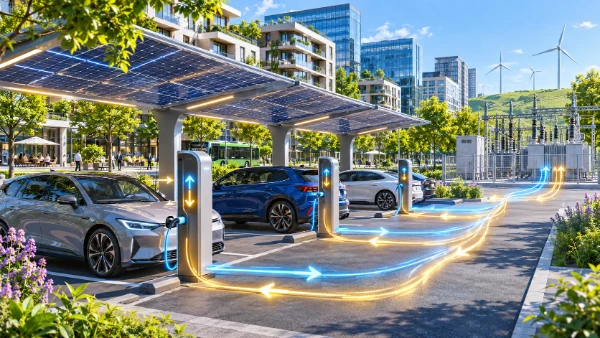
Electricity networks must continuously balance generation with consumption, which becomes more challenging as wind and solar power account for a larger share of supply. Solar generation can be particularly strong during daylight hours, while household electricity demand frequently rises later in the day. Wind output also changes with weather conditions. Batteries can help address these differences by absorbing electricity when production is abundant and releasing it when the network needs support. Volkswagen’s V2G proposal makes use of batteries that customers have already purchased for transport, potentially providing additional energy storage without installing a separate large battery at every participating home.
The wider environmental benefit depends on when the batteries charge and discharge. Storing surplus renewable electricity can reduce waste when generation exceeds what the network can use. Volkswagen reported that approximately 9,500 GWh of renewable electricity had been curtailed in Germany during a referenced period, illustrating the scale of the storage challenge. However, sending electricity through a vehicle battery also involves energy losses. V2G therefore offers its greatest value when intelligently timed charging and exports avoid more expensive or higher-emission generation. It should not be assumed that every discharge automatically reduces carbon emissions or that a single vehicle can make a measurable difference to national electricity demand.
Thousands of connected vehicles could have a more substantial collective effect. Elli plans to combine the flexible capacity of participating batteries so it can be managed and offered to electricity markets. This arrangement can help network operators respond to changing demand without requiring drivers to negotiate directly with energy traders. Volkswagen is also working with The Mobility House Energy, whose technology supports the management of distributed batteries and bidirectional charging. Successful expansion would depend on sufficient participation, reliable communication between equipment and energy services, and electricity market rules that allow households to receive appropriate compensation for providing flexibility.
When Will Volkswagen Vehicle-to-Grid Reach the UK and Other European Countries?
Germany is the starting point for Volkswagen’s 2026 commercial introduction. The company has identified France and the United Kingdom among the countries that could join later, but it has not confirmed a specific UK launch date. Expansion depends on technical compatibility, national electricity regulations and the availability of suitable products and contracts. British customers therefore should not assume that buying a compatible Volkswagen ID. vehicle in 2026 immediately provides access to Elli’s German V2G offer. Local electricity tariffs, export arrangements, smart metering requirements and approved charging equipment will need to be established before the service can operate commercially in each market.
The UK has particular reasons to be interested in vehicle-based energy storage because its electricity supply increasingly includes variable renewable generation, especially offshore wind. Electric cars connected at homes and workplaces could eventually help manage periods of high demand or excess generation. Yet existing domestic export tariffs and smart charging services are not necessarily equivalent to Volkswagen’s V2G programme. A conventional smart charger can schedule when electricity enters a battery but cannot automatically return energy to the grid. British drivers considering future participation should distinguish between ordinary smart charging, vehicle-to-home capability and a fully approved arrangement for exporting electricity through their car.
Volkswagen’s 2026 initiative marks an important development in the relationship between electric vehicles and electricity networks, although widespread adoption will take longer than a single product launch. The technology offers a practical route towards lower charging expenses and better use of renewable power, particularly for drivers who regularly park at home and can leave their vehicles connected for extended periods. Its success will ultimately depend on affordable equipment, transparent compensation, dependable battery protection and clear national regulations. For now, the most useful step for interested owners is to check vehicle compatibility and follow the confirmed local rollout rather than treating future earning estimates as guaranteed savings.