
Stellarators in 2026: How New Magnetic Coil Designs Could Change Fusion Reactors
Stellarators have spent decades living with an unusual contradiction. From a physics point of view, they offer several qualities that a future fusion power station would value: they can confine plasma without relying on a large current flowing through it, they are naturally suited to long-duration operation, and they avoid some of the disruptive events that complicate tokamak operation. Their weakness has traditionally been engineering rather than basic principle. Producing the carefully twisted magnetic field required by a stellarator often meant surrounding the plasma with large, three-dimensional superconducting coils that were difficult to design, manufacture and assemble. By 2026, that problem is being approached in a very different way. New optimisation methods, high-temperature superconductors and, in some projects, flat or planar magnetic coils are being developed together rather than separately. The result is not yet a commercial fusion reactor, but it is a significant change in how engineers think about stellarators: instead of accepting magnetic complexity as unavoidable, they are increasingly designing the plasma and the magnet system around the realities of manufacturing, maintenance and eventual power-station operation.
Why Magnetic Coil Design Has Become Central to Stellarator Development
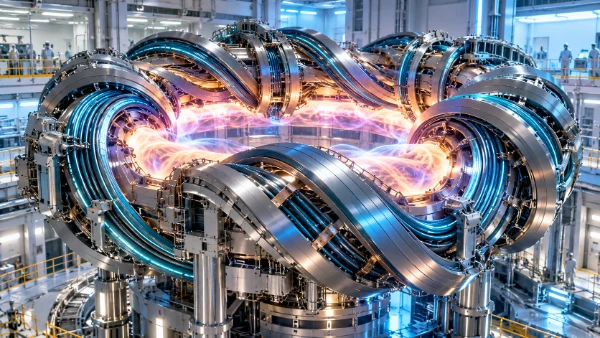
A stellarator confines extremely hot plasma inside a magnetic field that twists around a ring-shaped chamber. The basic goal is similar to that of a tokamak: keep the plasma away from material walls for long enough, at a sufficiently high temperature and density, for useful fusion reactions to become possible. The important difference is how the required magnetic geometry is created. A tokamak obtains part of its magnetic configuration from a strong electric current flowing through the plasma itself. A stellarator can create its confining field mainly with external magnets. This removes the need to maintain a large plasma current continuously and reduces the risk of the major current-driven disruptions associated with tokamaks. In principle, that makes the stellarator particularly attractive for a power station expected to operate steadily rather than in repeated pulses. The price is that the external magnets must reproduce a far more complicated magnetic shape with very high accuracy.
Wendelstein 7-X in Greifswald, Germany, remains the clearest demonstration of how far this approach has progressed. Its superconducting magnet system creates an intricately shaped magnetic field around a plasma chamber that looks noticeably different from the simpler circular form associated with many tokamaks. The machine has shown that such a field can be built accurately and that an optimised stellarator can confine high-temperature plasma at a level once considered difficult for this type of device. During its 2025 experimental campaign, Wendelstein 7-X maintained a record long-pulse value of the fusion-relevant triple product for 43 seconds. A peer-reviewed paper published in July 2026 reported performance comparable with tokamak levels under stable, peaked-density conditions. After a maintenance period, experimental operation was scheduled to resume in September 2026, with the long-term objective of demonstrating high-performance plasma operation over much longer periods.
These results change the engineering question. Stellarator researchers no longer have to argue only that complex magnetic fields can work; Wendelstein 7-X has provided strong experimental evidence that an optimised configuration can deliver high-quality confinement. The problem is now how to turn that scientific achievement into machinery that could reasonably be built more than once. A commercial reactor would need magnets that can be manufactured to reliable tolerances, inspected, installed, cooled, repaired and eventually replaced without making the entire plant impractical. It must also leave enough physical space for neutron shielding, a breeding blanket in a deuterium-tritium reactor, heating equipment, diagnostics and systems that remove heat and particles from the plasma. Coil design therefore affects far more than magnetic performance. It influences the dimensions, cost, maintainability and construction sequence of almost every major part of a stellarator.
From Complex Three-Dimensional Magnets to Planar Coil Systems
One of the clearest attempts to simplify the traditional stellarator magnet is the planar-coil approach being developed by Thea Energy. Instead of requiring every shaping magnet to follow an elaborate three-dimensional path, its proposed Helios power-plant design uses two groups of flat superconducting magnets. Twelve large encircling coils provide the main magnetic field around the machine, while 324 smaller shaping coils are intended to modify that field locally. Each shaping coil can be controlled individually. In the published 2026 Helios studies, these coils are circular, planar and designed as repeated units rather than as hundreds of unique three-dimensional components. The important change is not that the magnetic field itself becomes simple; the plasma still needs a carefully tailored three-dimensional field. The change is where the complexity resides. More of it moves from the physical shape of the magnets into their arrangement, electrical control and computational optimisation.
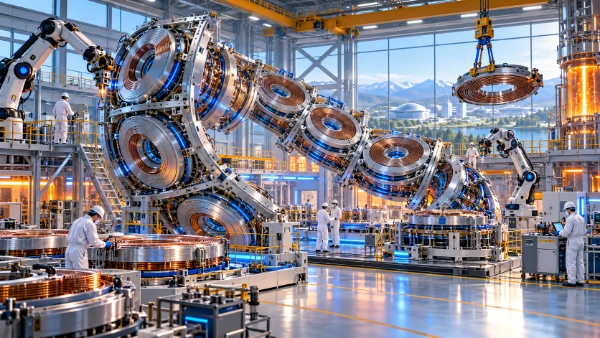
This concept passed an important hardware milestone in May 2026 when Thea Energy reported operating its first full-size Eos-specification planar shaping coil at the intended current and magnetic-field conditions. Eos is the company’s planned integrated stellarator intended to test the approach before a power station such as Helios is attempted. The result does not show that Eos can yet produce a fusion plasma or that Helios will generate electricity, but it provides physical evidence that one of the central magnet components can be manufactured and operated at relevant scale. The US Department of Energy also documented a September 2026 project supporting further development of the planar shaping magnet manufacturing process, including a pilot production line and a planned batch of 100 magnets. That matters because a design based on repeated coils only delivers its promised advantage if those coils can genuinely be produced consistently in quantity.
Planar coils could also change how engineers deal with manufacturing errors. In a conventional stellarator, an error in the position or shape of a specialised three-dimensional coil can distort the magnetic field and may be difficult to compensate after assembly. A large set of independently powered shaping coils offers another possibility: small field corrections can be made electrically by adjusting individual currents. This does not eliminate the requirement for accurate construction, nor does it mean that flat coils are automatically cheaper. Hundreds of superconducting magnets need their own supports, electrical connections, cooling arrangements, power electronics and protection systems. Yet the underlying engineering task becomes closer to producing a family of repeatable industrial components. For fusion, where construction cost and maintainability may ultimately matter as much as peak plasma performance, that shift could prove more important than simply producing a stronger magnetic field.
High-Temperature Superconductors and Better Optimisation Are Changing the Magnet
The second major development is the growing use of high-temperature superconducting, or HTS, materials. The name can be misleading because these conductors still operate at cryogenic temperatures, but they can function at higher temperatures and, in suitable conditions, carry very large currents and tolerate stronger magnetic fields than many conventional low-temperature superconductors. For stellarator designers, stronger magnets create options. A reactor can potentially be made more compact, additional space can be left between the plasma and coils, or the magnetic configuration can be adjusted without immediately exceeding the limits of the conductor. Proxima Fusion is using HTS technology in its Stellarator Model Coil, or SMC, which was in manufacturing during 2026 and is intended to test a large non-planar stellarator magnet. The company states that testing is planned at CEA Saclay in France by the end of 2027 before the technology is applied to its larger Alpha stellarator programme.
Type One Energy is following a different route that also combines stellarator optimisation with HTS magnets. Its Infinity One project in Tennessee is intended to use non-planar high-temperature superconducting magnets rather than replacing three-dimensional coils with a fully planar set. The company lists commissioning and start-up of Infinity One for 2029. Infinity One is not planned as a commercial electricity-producing reactor; it is a prototype intended to reduce engineering risk and develop manufacturing and operating experience. The subsequent Infinity Two concept is being designed as a 400 MWe fusion power station. These projects illustrate why there is no single accepted answer to the stellarator coil problem in 2026. One group is trying to simplify coil geometry radically, while another is retaining shaped coils but combining them with stronger superconductors, improved manufacturing methods and more advanced computational design.
Computational optimisation has itself advanced quickly. A stellarator coil cannot be designed simply by asking a computer for the most accurate magnetic field. A mathematically excellent coil may be too tightly curved to manufacture, may collide with another component, may experience excessive mechanical force or may leave no room for maintenance equipment. In August 2026, researchers from the Max Planck Institute for Plasma Physics and US institutions published a new augmented-Lagrangian approach to stellarator coil optimisation in Physical Review Letters and Physical Review E. The method was demonstrated on five different stellarator configurations and was designed to find better compromises between magnetic accuracy and practical constraints. For a non-specialist, its importance is straightforward: engineers are becoming better at asking the computer for coils that are not merely good on paper, but closer to shapes and arrangements that could actually form part of a reactor.
Software Is Beginning to Design the Magnet and Reactor Together
Older stellarator development often followed a difficult sequence. Physicists first identified a plasma shape with desirable confinement properties, and engineers then faced the task of building magnets capable of creating it. If the resulting coils were too complex, too close together or subject to unacceptable forces, the design could require repeated adjustment. Newer approaches increasingly combine these stages. The 2026 Helios design work, for example, uses single-stage optimisation methods that consider the plasma equilibrium and the planar coil set together. The intention is to prevent a situation in which an attractive plasma configuration can only be created with impractical hardware. Similar ideas are appearing across stellarator research, where coil curvature, distance from the plasma, magnetic-field quality and engineering space are increasingly treated as connected requirements from the beginning rather than as separate problems solved one after another.
The structures holding the magnets are also becoming part of the optimisation problem. Strong superconducting coils experience enormous electromagnetic forces, and increasing magnetic-field strength can make their mechanical support as challenging as the conductor itself. A 2026 study of a 10-tesla stellarator magnet support used topology optimisation to reduce the calculated structural mass from about 11.3 tonnes to roughly 1.2 tonnes while keeping the model within its specified mechanical limits. That result relates to a particular design study, not to a complete reactor, and it should not be read as evidence that the support mass of every stellarator can be reduced by the same proportion. It demonstrates something more useful: magnet performance cannot be considered independently of the steel or other structures needed to hold the coils in place. Future designs increasingly need to optimise the conductor, support and magnetic geometry as one connected system.
This is especially important for HTS materials because very high magnetic fields introduce practical limits that computer models cannot remove. Superconducting tape must be protected from excessive strain. Joints between conductors must carry large currents reliably. Cooling systems must remove heat, and the magnets must survive abnormal conditions in which part of a superconductor loses its superconducting state, a process commonly called a quench. In a power reactor, the coils must also operate for years near equipment exposed to energetic neutrons. Greater magnetic strength is therefore valuable only if the complete magnet assembly remains reliable. The most credible 2026 designs recognise this reality. They increasingly include structural analysis, cooling, electrical protection, maintenance access and manufacturability at an early stage instead of presenting magnetic-field strength alone as the measure of progress.
How Simpler Coils Could Change the Economics and Operation of Fusion Reactors
If the newer magnet approaches succeed, their largest effect may be on construction rather than on the fusion reaction itself. The underlying reaction does not become easier because a coil is flat or because an optimisation algorithm is better. Deuterium and tritium still need to be heated to extreme temperatures, their energy must be confined, and the reactor must manage intense heat and neutron loads. What changes is the machinery surrounding that plasma. A reactor assembled from repeatable magnet modules could rely more heavily on factory production, standardised quality control and planned replacement procedures. Reducing the number of extremely specialised parts would also make it easier to establish additional manufacturing capacity. This distinction is important because a successful experimental device can tolerate bespoke components and lengthy assembly work in a way that a fleet of electricity-generating stations cannot.
Current power-station studies show how directly magnet choices affect the rest of the design. The 2026 preconceptual Helios studies describe a machine with an approximately eight-metre major radius, a six-tesla magnetic field on the plasma axis and an electrical system modelled to deliver about 390 MWe net from roughly 1.1 GW of thermal power. Type One Energy’s Infinity Two concept targets 400 MWe. These figures are design values, not measured electricity production: neither plant exists as an operating fusion power station in 2026. Their significance is that stellarator development has moved beyond isolated calculations of plasma confinement. Designers are now trying to fit magnets, heat exhaust, structural materials, power supplies, maintenance space and electricity-generation equipment into internally consistent plant concepts. Coil geometry can determine whether enough room exists for many of those systems.
Adjustable coil systems may offer an operational advantage as well. A stellarator’s magnetic configuration is largely determined by its external magnets, so a system containing many independently controlled coils could provide additional ways to correct small construction errors or tune the field between operating scenarios. That could make commissioning less dependent on achieving a single perfect geometry during assembly. It could also allow engineers to respond to changes observed during operation. There are limits: current adjustment cannot correct every structural error, and hundreds of controlled coils add electrical equipment and potential failure points. Even so, the ability to combine physical precision with active magnetic correction represents a different design philosophy from treating every magnet as a fixed sculpted component whose geometry alone must deliver the final field.
What Must Happen Before New Stellarator Coils Can Be Called a Breakthrough
The next test is therefore hardware at increasing scale. Thea Energy has demonstrated a full-size Eos shaping coil, but Eos must still show how a large array of such magnets performs as an integrated stellarator system. Proxima Fusion is manufacturing its Stellarator Model Coil and plans to use the result to reduce risk before constructing Alpha, its proposed demonstration stellarator for the early 2030s. Type One Energy is progressing towards the Infinity One prototype, with commissioning currently listed for 2029. At the same time, Wendelstein 7-X continues to provide the experimental physics basis against which newer designs can be judged. Its 2026 campaigns are particularly relevant because stellarators ultimately justify their engineering complexity through the promise of stable, sustained operation. A new magnet concept becomes meaningful only when it preserves that advantage rather than simplifying construction at the expense of plasma performance.
Several reactor-level questions also remain open. Magnets must operate reliably beside a neutron-producing deuterium-tritium plasma; components facing the plasma must tolerate severe heat loads; exhaust systems must remove helium and impurities; and a commercial reactor would need a workable method for breeding and handling tritium. Maintenance has to be possible even after components become activated by neutron exposure. The magnet system also has to function for long periods without its power supplies, cryogenic equipment or electrical joints becoming unacceptable sources of downtime. Coil simplification can make these tasks easier by creating more space or improving access, but it cannot solve them on its own. This is why claims about future stellarator power stations should be separated from measured results. A successful coil test is important evidence for one subsystem, not proof that a complete fusion power station is ready.
As of 2026, the strongest case for the stellarator is no longer based on a single dramatic result. It comes from several developments beginning to reinforce one another: Wendelstein 7-X has strengthened the experimental case for optimised stellarator confinement; HTS technology offers stronger and potentially more compact magnets; planar-coil research is testing whether magnetic complexity can be produced with simpler hardware; and modern optimisation is bringing plasma physics, magnet geometry and engineering constraints closer together. None of this guarantees that a stellarator will become the first commercially successful fusion reactor, and no stellarator power station is generating net electricity today. What has changed is the nature of the obstacle. The complicated coil system that once appeared to be an unavoidable disadvantage is becoming an active field of engineering innovation. If those new designs survive full-machine testing, long-duration operation and realistic maintenance requirements, magnetic-coil development could become one of the technologies that turns the stellarator from an impressive experiment into a credible power-station design.