
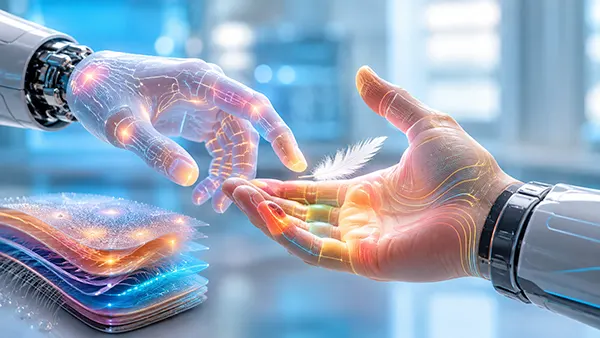
Electronic Skin for Robots and Prostheses: Touch, Temperature and Pressure Sensors
Electronic skin, usually shortened to e-skin, is a flexible sensory layer designed to give machines information that ordinary plastic, metal or silicone surfaces cannot provide. It can register contact, measure how strongly an object is being held, identify changes in temperature and, in more advanced designs, detect slipping, vibration or surface texture. These abilities matter because a robot that can feel is less likely to crush a fragile item or collide with a person, while a prosthetic hand with sensory input can offer its user more useful information about a grip. By 2026, e-skin has progressed from isolated laboratory pressure pads to larger, softer and increasingly multimodal prototypes, although fully human-like artificial skin is not yet a routine commercial or clinical product.
How Electronic Skin Turns Contact into Usable Information
Human skin combines protection, flexibility and sensation in one continuous organ. Electronic skin tries to reproduce part of that function with thin sheets made from elastomers, silicones, hydrogels, conductive polymers or composite materials. These sheets can bend around a robotic finger, cover a curved gripper or fit over parts of a prosthetic hand without preventing movement. The material itself does not need to look like biological skin. Its main purpose is to remain comfortable or mechanically compatible with the device while carrying sensors and conductive paths across an uneven surface.
Most e-skin sensors work by changing an electrical property when they are touched, stretched, heated or compressed. A pressure-sensitive layer may change its electrical resistance, while a capacitive sensor may register a change in the distance between two conductive layers. A temperature sensor can respond because its resistance or voltage varies as it becomes warmer or cooler. Small electronic circuits then convert these changes into data that a robot controller or prosthetic feedback system can interpret. The basic principle is straightforward: a physical event creates a measurable electrical response, and software determines what that response means.
There are two broad design approaches. One uses arrays of many separate sensing points, much like pixels in a camera, so the system can build a pressure or temperature map. The other treats a larger piece of conductive material as a single distributed sensor and calculates where and how it was touched from signals measured at its edges. Sensor arrays can provide clear local readings but may require extensive wiring and careful assembly. Distributed designs can cover large or complex shapes with fewer connections, although their mixed signals often need calibration and machine-learning models to separate touch, heat, strain and damage.
Touch Sensors for Texture, Slip and Object Handling
In everyday language, touch includes several different events. A light tap, a firm press, a sliding object and a vibrating tool all create different patterns of force. Electronic skin detects these patterns through changes across one sensor or a group of sensors. A simple system may only confirm that contact has occurred. A more capable design can estimate the contact area, the direction of movement and how quickly the force is changing. This added detail allows a robot to distinguish between resting a finger on an object and actively gripping or rubbing its surface.
Slip detection is especially important for robotic hands. Pressure acting directly into a fingertip is called normal force, while force moving across the surface is often described as shear force. When a cup, tool or piece of fabric starts to slide, the balance between these forces changes before the object falls. A tactile sensor that separates normal and shear forces can tell the controller to tighten the grip only as much as necessary. In 2026, researchers demonstrated miniature graphene and liquid-metal composite sensors able to measure three-dimensional force, surface roughness and early slip while remaining small enough for robotic fingertips.
For prostheses, detecting touch is only the first half of the task. The information must also reach the user in a form that can be understood. Some experimental systems translate grip force into vibration on the residual limb, mild electrical stimulation on the skin or signals delivered through implanted nerve interfaces. Each method has different advantages, training requirements and medical considerations. A sensitive prosthetic fingertip therefore does not automatically restore a natural sense of touch. Useful performance depends on the complete loop: sensing the contact, processing the signal, delivering feedback and helping the user associate that feedback with the artificial hand.
Temperature and Pressure Sensing in Real Tasks
Temperature sensors add information that vision alone cannot reliably provide. A robot may see two identical cups but cannot know which one contains a hot drink without direct measurement. An e-skin temperature sensor records the thermal change at the contact point and can trigger a warning, alter the grip or stop the movement. In prosthetic devices, temperature information could help a user recognise hot and cold objects, but the sensor reading still has to be translated into safe and understandable feedback. The system must also distinguish the temperature of an object from changes caused by room conditions, body heat or prolonged contact.
Pressure sensing has several practical roles. On a robotic gripper, it shows whether force is distributed evenly and whether one finger is carrying too much load. On a prosthetic hand, pressure readings can support more controlled grasping of objects such as fruit, paper cups or glassware. Sensors can also be placed inside a prosthetic socket, where they may help monitor local pressure and temperature at the interface with the user’s skin. Persistent pressure, friction and heat can contribute to discomfort or tissue irritation, so reliable monitoring may assist clinicians and prosthetists when adjusting fit, alignment or daily wearing routines.
Measuring temperature and pressure at the same time is harder than placing two independent sensors next to each other. Soft materials often respond to several influences at once: pressing a sensor can change its resistance, but warming it may produce a similar electrical shift. Stretching around a joint can add another source of error. Engineers address this problem through layered structures, separate sensing channels, reference sensors or data models trained to recognise different signal patterns. The aim is not merely to produce more data, but to prevent a temperature change from being mistaken for pressure or a bend in the material from being reported as touch.
Combining Signals for Safer Robotic and Prosthetic Control
Touch becomes more useful when several measurements are interpreted together. A pressure map can show where an object is held, shear sensing can reveal that it is beginning to slip, and temperature sensing can indicate whether the surface is safe to handle. The combination can also help distinguish objects that create similar visual images. A rigid metal container and a soft insulated cup may have comparable shapes, yet they produce different patterns of pressure, deformation and heat transfer. Multimodal e-skin gives the control system more evidence before it chooses how to move.
For robots, this sensory combination supports closed-loop control. Instead of following a fixed gripping command, the machine continuously compares its action with incoming sensor data. It can reduce force when a fragile object begins to deform, increase force when slipping starts or release an item when the detected temperature exceeds a safe limit. This approach is useful in warehouses, food handling, care environments, laboratories and remote manipulation, where objects vary in size and condition. It also improves interaction around people because contact can be detected across a wider area rather than only at a few rigid force sensors.
For a prosthetic user, more signals do not always mean better feedback. A system that reports every minor pressure and temperature change may be distracting, tiring or difficult to interpret. Designers therefore need to select the information that supports a real action, such as confirming contact, showing grip strength or warning about heat. Feedback intensity must be adjusted to the individual because skin sensitivity, nerve condition, socket design and personal preference differ. Training is equally important: the user needs time to connect a vibration, electrical pulse or thermal cue with what is happening at the prosthetic fingers.
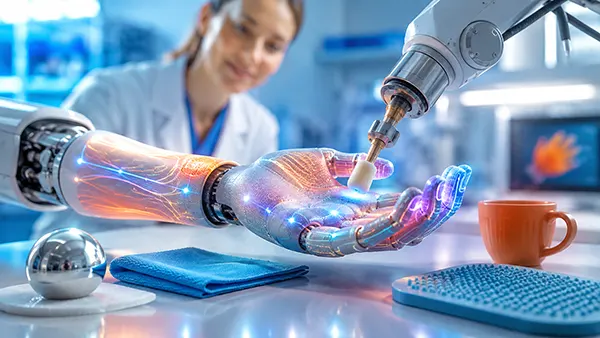
The State of Electronic Skin Technology in 2026
One notable direction is the use of a single soft material to sense several kinds of contact across a large surface. In 2025, researchers from the University of Cambridge and University College London reported a gelatine-based conductive hydrogel formed into a hand-shaped robotic skin. The entire material acted as a sensor, while 32 electrodes at the wrist collected signals associated with touch, pressure, heat, multiple contact points and physical damage. Machine learning was used to classify the patterns. The work showed how large-area sensing may be simplified, but the researchers also stated that the material was not yet as sensitive as human skin and still required durability improvements.
Another research path focuses on skin-like electronics that produce signals closer to biological nerve impulses. Stanford researchers previously demonstrated a soft, stretchable multilayer e-skin that could sense pressure, temperature and strain while operating at low voltage and generating pulse-like electrical outputs. Other teams have developed self-healing polymers, ionically conductive gels and printable materials that can recover part of their mechanical or sensing performance after damage. These projects address a practical weakness of soft sensors: they are placed on the outside of a device, so cuts, repeated bending and abrasion are unavoidable during normal use.
Current uses remain uneven. Tactile skins are already valuable in research robots, specialised grippers, teleoperation systems and soft robotic devices, where controlled environments make calibration and maintenance easier. Prosthetic applications are more demanding because the equipment must be safe, comfortable, dependable and useful for many hours of daily activity. As of 2026, advanced sensory feedback is still mainly found in research studies, clinical trials and limited specialist systems rather than standard prosthetic care. The most realistic near-term progress is likely to come from focused functions, such as grip-force feedback, slip warnings or socket monitoring, before a complete artificial sense of touch becomes widely available.
Remaining Barriers and the Most Realistic Next Steps
Durability is one of the largest barriers. A useful e-skin must survive thousands of bends, repeated gripping, accidental impacts, cleaning, moisture, sweat and changes in ambient temperature. It must remain attached to a moving surface without peeling, cracking or losing calibration. Self-healing materials can reduce the effect of small cuts, but healing speed, electrical recovery and long-term stability still vary between designs. A laboratory sample that works for several demonstrations is not equivalent to a covering that can remain dependable on a prosthetic hand or service robot through months of daily use.
System design creates a second group of challenges. Large sensing areas generate substantial amounts of data, yet robotic and prosthetic devices have limited space, battery capacity and processing power. Too many wires can restrict movement and create additional failure points. Wireless links reduce cabling but introduce power and reliability concerns. Manufacturers also need production methods that deliver consistent sensor performance across curved shapes and replaceable parts. Progress therefore depends not only on more sensitive materials, but also on simpler electronics, efficient data processing, standard testing and practical repair procedures.
Prosthetic e-skin also requires careful human evaluation. Researchers must determine which sensations genuinely improve control, confidence and daily function, and which add complexity without a clear benefit. Neural interfaces may provide more natural feedback, but they involve medical procedures and long-term safety questions. Non-invasive vibration or electrical stimulation is easier to apply, although the sensation may feel less like touch from the missing hand. The next stage is likely to combine better sensors with personalised feedback and longer real-world trials. Success will be measured not by how closely a prototype resembles human skin in the laboratory, but by whether it remains reliable, affordable and genuinely useful in everyday tasks.