
Durable Anti-Corrosion Coatings for Marine Infrastructure and Ships in 2026
Marine corrosion is rarely “just rust”. It is a predictable, zone-driven process shaped by salt deposition, wet/dry cycling, UV, abrasion, temperature swings, and the constant presence of crevices and poor drainage. In 2026, long service life comes less from a single “miracle” product and more from disciplined specification: correct surface preparation, a coating system matched to the exposure zone, realistic film builds, and inspection hold points that prevent hidden defects from being sealed in.
Start with the Exposure Zones, Not the Product Name
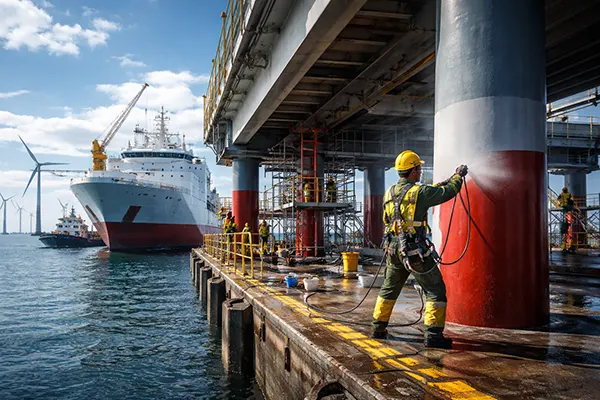
For ports, piers, locks, sheet piles, offshore wind foundations and ship structures, the most corrosive area is typically the splash and tidal zone. It combines oxygen, salts, impact, and repeated wetting and drying. A coating that survives full immersion may still fail here if it lacks abrasion resistance and flexibility, or if it is too brittle after cure. Treat splash/tidal as its own design problem, not an extension of “atmospheric paint”.
Atmospheric marine exposure (quayside steel, topsides, superstructures) is often controlled by UV stability and salt contamination management. The failure mode is frequently underfilm corrosion that starts at edges, welds, fasteners and cut-outs, then spreads under the topcoat. Good detailing (rounded edges, sealed crevices, stripe coats) can add years of life even before you choose the coating chemistry.
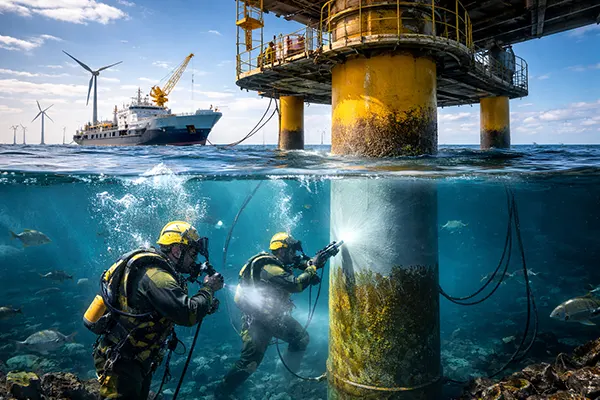
Immersion (sea chests, pilings below waterline, seawater intakes, ballast tanks) brings different constraints: water permeability, resistance to cathodic disbondment, and tolerance of imperfect access during application. Where cathodic protection is present, the coating must be compatible with it and robust against holidays. In practice, owners get the best results when they specify inspection lighting, access, drainage and drying as seriously as they specify paint.
Durability Benchmarks in 2026: What “Long Life” Usually Means
In ship ballast tanks, the most widely referenced benchmark remains the IMO Performance Standard for Protective Coatings (PSPC), which is aimed at a useful coating life of 15 years when properly applied and maintained. That target is only realistic when surface prep, edge treatment, stripe coating, and film thickness control are built into the build plan rather than left to workmanship on the day.
For offshore and coastal structures, ISO 12944’s newer “CX (offshore)” corrosivity category and the Im4 immersion category are commonly used to frame durability expectations and test regimes. The practical value of this approach is that it forces you to declare the environment clearly (offshore, splash, immersed, with/without cathodic protection), then select a proven system rather than guessing from a generic “marine grade” label.
In oil & gas and increasingly offshore wind supply chains, NORSOK M-501 is used as a high-bar qualification route that links surface preparation, application, and verification to pre-qualified coating system data. Even if you do not require full NORSOK compliance, its logic is useful: define a system by zone, require measurable checks (surface profile, salt, DFT, adhesion), and keep the documentation tight enough that future repairs can match the original build-up.
Coating System Choices That Actually Deliver Long Service
For many steel assets in marine atmosphere, a “workhorse” stack still performs best: a zinc-rich primer (or zinc-rich epoxy), followed by high-build epoxy intermediates, then a UV-stable topcoat such as aliphatic polyurethane or polysiloxane. The zinc layer offers galvanic protection where minor damage occurs, while the epoxy provides barrier resistance. The topcoat is chosen for colour/gloss retention and weathering, not for corrosion resistance alone.
In splash/tidal and high-abrasion areas, glass-flake reinforced epoxies remain a leading choice because the lamellar flakes reduce permeability and improve impact and abrasion resistance when properly formulated and applied at the intended thickness. The key word is “properly”: glass-flake systems are unforgiving of poor mixing, wrong thinner choice, or thickness control issues that create cracking or solvent entrapment. When they are applied to spec, they can significantly reduce maintenance frequency on offshore steelwork.
For extreme longevity on offshore structures, thermal spray aluminium (TSA) with an appropriate sealer is still one of the most durable options available, particularly where access for future repainting will be difficult and life-cycle cost matters more than initial cost. TSA is not a universal solution: it demands controlled surface preparation, skilled applicators, and careful interface management with bolted connections and dissimilar metals. But when the project has the right controls, TSA is a credible “multi-decade” strategy.
What to Specify in Real Terms: Film Build, Stripes, and Interfaces
Long-life specifications in 2026 are written around measurable targets: surface cleanliness (commonly abrasive blast to Sa 2½), surface profile range, maximum soluble salt levels, ambient conditions during application, and a minimum dry film thickness (DFT) for each coat and total system. Owners who only state “high-build epoxy” without numeric controls are effectively accepting uncontrolled variation, which is a polite way of accepting early breakdown.
Stripe coating is not optional in marine work; it is the cheapest life-extension step you can buy. Edges, welds, cut-outs, stiffeners, drain holes and bracket toes are where coatings thin out and corrosion starts. A practical spec calls for edge rounding where feasible, then one or two stripe coats on critical geometry before full coats, with documented DFT readings that prove the stripes were not just a quick brush-over.
Interfaces are where most surprises live: coating transitions near immersion lines, areas under clamps and supports, and boundaries between coated steel and concrete, FRP, or timber. A robust spec defines how those transitions are sealed, how drainage is maintained, and how touch-up will be performed after erection and welding. If you do not control interfaces, the coating system can be excellent on paper and still fail first at the seams.
Surface Preparation and Quality Control: Where Service Life Is Won
Most premature failures trace back to preparation, not chemistry. Residual salts, moisture, mill scale in corners, and grease contamination undermine adhesion and accelerate underfilm corrosion. In marine environments, soluble salt testing is often the difference between a coating that looks fine at handover and a coating that blisters months later. In 2026, it is reasonable to require documented salt measurements, not just visual blast standards.
Environmental control matters because it governs cure and film formation. Dew point discipline, ventilation, and correct recoat windows prevent amine blush, solvent entrapment and weak intercoat adhesion—problems that are expensive to fix once the asset is in service. This is why high-spec projects define hold points: blasting acceptance, pre-paint inspection, first coat sign-off, stripe coat verification, and final DFT mapping.
Inspection should be designed to be useful later, not just to pass today. A good coating dossier includes surface prep records, batch numbers, mixing logs, WFT/DFT readings, repaired areas, and photographs of difficult geometry before it is closed in. When damage occurs (and it will), this dossier tells the maintenance team what system they are matching, what thickness to restore, and what surface prep is realistic in that location.
Maintenance Planning: Keeping “Long Life” Honest
Even the best coating system needs a realistic maintenance strategy. Long life does not mean “ignore it for 15 years”; it means the coating remains in good condition with planned inspection intervals and timely repairs of local damage. A practical approach is zone-based inspections: splash and high-traffic areas first, atmospheric areas next, then immersion spaces based on access and operational constraints.
Repair specifications should be written before the first coat is applied. They define how to treat edges of damaged coating, what degree of power-tool cleaning is acceptable when blasting is impossible, how to feather and seal old coatings, and how to verify adhesion. Without a repair method, crews improvise, and the repair becomes the weakest link that allows corrosion to creep under otherwise sound paint.
Finally, owners benefit from aligning coating choices with operational realities: turnaround time in dry dock, allowable cure time at low temperatures, and the likelihood of mechanical damage from fenders, chains, cargo handling or ice. In 2026, the most reliable projects are those that treat corrosion protection as an engineering system—materials, workmanship, inspection and maintenance—rather than a purchasing decision made at the end.